

What is Kakuro?
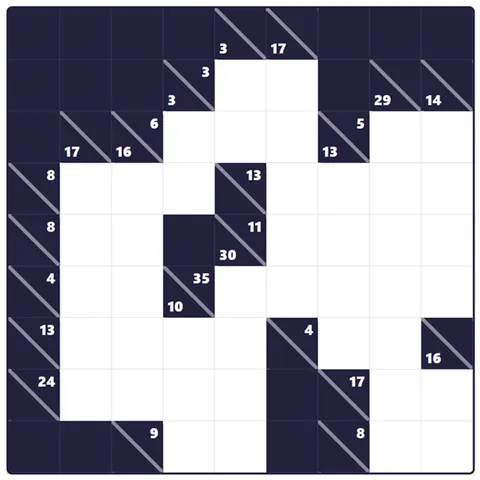
Kakuro is a logic puzzle built from horizontal and vertical runs of white cells. Each run has a clue sum shown in a black cell with a diagonal split. You fill the white cells with digits from 1 to 9.
A Kakuro run works like a mini combination puzzle. The digits in a run must add to the clue total, and no digit may repeat inside that run. Because every white cell belongs to both an across run and a down run, the two clues cross-check each answer.
- Each white cell contains one digit from 1 to 9.
- Digits may not repeat inside the same across run.
- Digits may not repeat inside the same down run.
- The sum of each run must match its clue.
- Every cell is constrained by both an across clue and a down clue.
How to play Kakuro
Start with the smallest or most restrictive runs. A two-cell run summing to 3 can only be 1 and 2. A two-cell run summing to 17 can only be 8 and 9. These fixed combinations are the natural opening moves.
Once you know the candidate digits for a run, compare them with the crossing clue. If a cell belongs to a 16-across run that can only use 7 and 9 in that spot, but the down clue cannot accept 9 there, the answer must be 7.
- Click a white cell to select it.
- Use the digit buttons or keyboard to enter a value.
- Use Erase to clear the selected cell.
- Use Check to highlight current mistakes.
- Use Hint if you want one correct digit revealed.
Kakuro sizes and difficulty
The 6x6 Kakuro is the fastest warm-up and a good entry point for new solvers. The 7x7 and 8x8 boards give you a fuller web of crossing sums, while 9x9 to 11x11 boards create richer deduction chains and bigger clue totals.
Difficulty comes from how open the grid feels. Easy puzzles lean on clearer combinations and shorter chains. Hard puzzles leave more candidate overlap, so you need to compare across and down runs more carefully.
- 6x6: compact starter boards and quick daily plays.
- 7x7: balanced Kakuro sessions with more crossing logic.
- 8x8 and 9x9: larger grids with longer runs and bigger sums.
- 10x10 and 11x11: deeper puzzles for longer sessions.
- Easy: more direct combinations and faster starts.
- Hard: more overlap, fewer obvious openings, deeper deduction.
Core Kakuro strategies
The first technique is combination memory. You do not need to memorise every possible sum, but you should notice distinctive pairs and triples. Low totals and high totals are especially useful because they allow fewer combinations.
The second technique is overlap. If a 24 clue over four cells can only use 3, 5, 7 and 9, and the crossing clue removes 9 from one position, the remaining digits narrow immediately. Kakuro rewards this steady intersection work.
- Begin with short runs and extreme sums.
- Look for runs where only one combination is possible.
- Use crossing clues to eliminate digits from a run.
- Watch for forced placements after one digit is fixed.
- Treat every run as a set of possible combinations, not just a total.
How this online Kakuro generator works
This page builds a fresh Kakuro layout in your browser, fills the white runs with valid digits, and then converts those finished runs into the across and down sums you see on the board.