
What is a Nonogram?
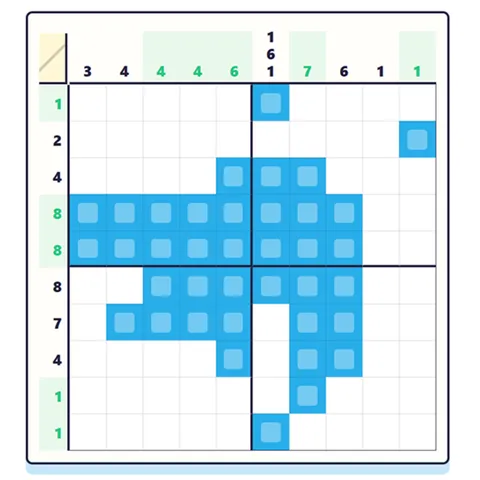
A Nonogram is a picture logic puzzle played on a rectangular grid. Numbers beside each row and above each column tell you how many filled squares appear in that line.
The numbers are listed in order. A clue of 3 1 means there is a run of three filled cells, then at least one empty cell, then a run of one filled cell. The exact positions are found by comparing row clues with column clues.
- Fill cells that must belong to a clue run.
- Cross cells that cannot be filled.
- Leave uncertain cells blank until another clue proves them.
- Every clue number must appear in order.
- Different clue groups need at least one empty cell between them.
How to play Nonograms
Start with the largest clues. If a 10-cell row has a clue of 8, that block must overlap no matter where it begins, so some middle cells are guaranteed to be filled. Then use those confirmed cells to narrow the column clues.
Cross marks are just as useful as filled squares. When a clue run is complete, mark the empty cells around it. This prevents accidental overfilling and often reveals the next forced move.
- Choose Fill to shade cells that are definitely part of the picture.
- Choose Cross to mark cells that must stay empty.
- Right-click a cell to add a cross quickly on desktop.
- Use Check to highlight filled cells that conflict with the solution.
- Use Hint only when you want one correct square revealed.
Nonogram sizes and difficulty
Small 5x5 Nonograms are ideal for learning how clues overlap. A 10x10 puzzle gives a fuller picture while still staying quick. A 15x15 grid needs more patient scanning because a single clue can affect a much wider line.
Difficulty is shaped by clue density, the number of short broken runs and how much early overlap exists. Hard puzzles usually have more scattered runs, so cross marks become essential.
- 5x5: quick beginner puzzles and warm-ups.
- 10x10: balanced daily Nonogram play.
- 15x15: larger picture puzzles with more sustained logic.
- Easy: bigger clue runs and more obvious overlaps.
- Hard: shorter runs, more gaps and fewer immediate starts.
Core Nonogram strategies
The first important technique is overlap. Imagine placing a clue run as far left as possible and as far right as possible. Any squares covered in both positions must be filled.
The second technique is completion. Once a run is fixed, cross the cells immediately before and after it if they exist. That gap confirms the group is finished and protects the rest of the line.
- Work the longest clues first.
- Alternate between rows and columns after every confirmed mark.
- Use crosses to separate clue groups cleanly.
- Look for lines where existing fills force a clue into one position.
- Avoid guessing: a good Nonogram should keep producing logical deductions.
How this online Nonogram generator works
The game creates a fresh pixel pattern, converts it into row and column clues, then runs a browser-side solver to check whether those clues point to a single solution. That keeps the puzzle focused on logic rather than ambiguity.