

What is Norinori?
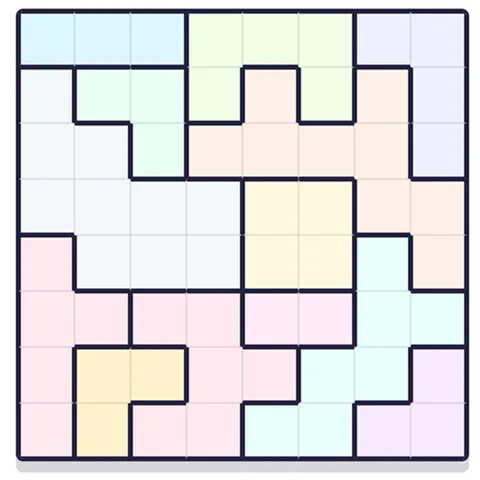
Norinori is a Japanese-style shading puzzle played on a grid divided into irregular regions. The player shades cells until every region contains exactly two shaded cells.
Those shaded cells also have a global rule: every shaded cell must be part of a domino, meaning it touches exactly one other shaded cell horizontally or vertically. Dominoes can sit inside one region or span two neighbouring regions.
- Each region must contain exactly two shaded cells.
- Every shaded cell must have exactly one shaded orthogonal neighbour.
- Shaded dominoes must not touch other dominoes orthogonally.
- Diagonal touching is allowed.
- Dominoes may cross region borders.
How to play Norinori
Start by looking for very small regions. A two-cell region must have both cells shaded. Once a domino is fixed, cells orthogonally touching that domino often become impossible because dominoes cannot merge into longer shaded chains.
Next, inspect regions with three or four cells. Ask which pair of cells can be shaded without creating an isolated cell or a shaded cell with too many neighbours. The solve usually grows from forced dominoes into neighbouring regions.
- Tap an empty cell to shade it.
- Tap a shaded cell again to unshade it.
- Use Check to highlight current rule violations.
- Use Undo to step back one move.
- Use Solution only when you want to reveal the generated answer.
Norinori solving strategies
The most useful Norinori habit is to think in dominoes, not individual cells. A shaded cell is never allowed to stand alone, and it is never allowed to touch two or more shaded neighbours.
If a potential shaded cell has no possible partner left, it cannot be shaded. If a region already has two shaded cells, every other cell in that region is unshaded. These two ideas carry a surprising amount of the solve.
- Fill two-cell regions immediately.
- Mark cells that cannot possibly find a domino partner.
- After placing a domino, block orthogonal cells that would attach to it.
- Remember that a region's two shaded cells can pair outside the region.
- Use cross-border dominoes to connect deductions between neighbouring regions.
Puzzle sizes and difficulty
The 6x6 board is best for learning the rules and getting quick wins. The 8x8 board gives a fuller Norinori solve, while the 10x10 board creates longer puzzles and can take a few seconds to generate.
Difficulty comes from region shape and how many early forced dominoes exist. Hard puzzles usually make you reason about cross-border dominoes more often.
- Easy: more immediate deductions and smaller regions.
- Medium: a mixed solve with cross-border logic.
- Hard: fewer obvious starts and deeper domino constraints.
How this online generator works
The generator starts by placing separated dominoes, then grows connected regions around them. It deliberately allows some dominoes to cross region borders because that is one of the best parts of Norinori logic.
After building a layout, the script runs a solver to check whether the puzzle has a single solution. For larger boards, that uniqueness check can take a few seconds, so this page shows a loading warning while the generator works.