



What is Killer Sudoku?
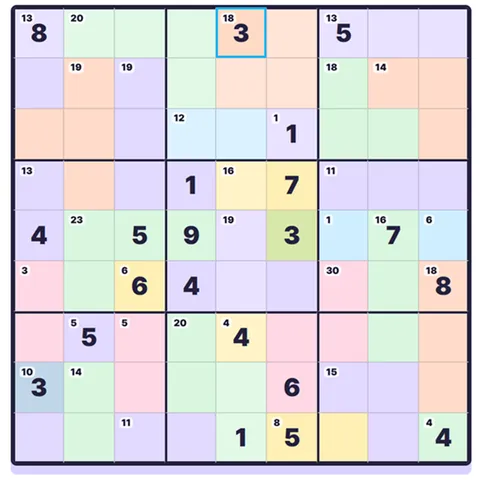
Killer Sudoku is a number-placement puzzle that blends standard Sudoku with arithmetic cages. The row, column and 3x3 box rules still apply, but there are usually no starting numbers.
Instead, the puzzle gives you cage totals. If a two-cell cage is marked 4, its cells must be 1 and 3 in some order. If a three-cell cage is marked 17, you know the digits must be a non-repeating combination that adds to 17.
- Every row contains the digits 1 to 9 once.
- Every column contains the digits 1 to 9 once.
- Every 3x3 box contains the digits 1 to 9 once.
- Every coloured cage adds to its printed total.
- Digits cannot repeat inside a cage.
How to play Killer Sudoku online
Start with the smallest cages. Single-cell cages give a fixed digit, while two-cell cages with totals like 3, 4, 16 or 17 have very few possible combinations.
Then combine cage sums with Sudoku placement. A cage that crosses a row, column or box can remove candidates from several places at once.
- Click or tap an empty cell.
- Use the number buttons or keyboard to place a digit.
- Turn on Notes to add small candidate digits.
- Use Auto notes to seed candidates from current Sudoku and cage rules.
- Use Check or Hint when you want a nudge.
Killer Sudoku difficulty levels
Easy puzzles include more small cages and direct totals. Medium puzzles use a balanced mix of two-cell and three-cell cages. Hard and Expert puzzles rely on larger cages, fewer immediate totals and more candidate work.
The generator checks each board for a single solution, then colours neighbouring cages differently so the puzzle stays readable without a cluttered cage outline.
- Easy: more direct cage totals and faster starts.
- Medium: a daily challenge with steady deduction.
- Hard: longer chains between cage sums and Sudoku regions.
- Expert: larger cages and fewer simple entries.
Killer Sudoku strategy tips
Learn common cage combinations. A two-cell cage totalling 3 must be 1 and 2; a two-cell cage totalling 17 must be 8 and 9. These tiny facts are the Killer Sudoku equivalent of obvious singles.
Watch where cages sit inside boxes. If a cage lies entirely inside one 3x3 box, its digits are locked into that box. If it spills across a boundary, the leftover cells in each region can become easier to calculate.
- Use small cage totals before scanning the whole grid.
- Look for cages contained inside a single row, column or box.
- Compare cage sums against the 45 total for each complete row, column and box.
- Keep notes tidy on hard puzzles.
- Avoid guessing; cage arithmetic usually gives another path.
The rule of 45: innies and outies
Every row, every column and every 3x3 box in Killer Sudoku contains the digits 1 to 9 exactly once, so each one totals 45. That single fact is the engine behind the puzzle's most powerful technique. When the cages inside a region add up to a known total, subtracting from 45 reveals the sum — and often the exact value — of the cells left over.
Solvers call those leftover cells innies and outies. An innie is a single cell inside a region that no full cage covers: if the cages sitting entirely inside a box span eight cells and total 38, the ninth cell must be 45 − 38 = 7. An outie is a cell from a cage that pokes just outside the region, and the same 45 arithmetic pins its value too. Stretch the idea across two or three boxes at once and even tightly packed grids start to open up.
- Each row, column and 3x3 box always totals 45.
- Add the cages that sit fully inside a region, then subtract from 45.
- A single leftover cell (an innie) is fixed at once by that subtraction.
- A cell spilling out of a region (an outie) is found the same way.
- Combine two or three regions to resolve cages that cross box borders.
Killer Sudoku cage combinations to know
Short cages with extreme totals can only be filled one way, and spotting them places digits instantly. A two-cell cage adding to 3 is {1,2}; to 4 is {1,3}; to 16 is {7,9}; to 17 is {8,9}. A three-cell cage of 6 is {1,2,3} and of 24 is {7,8,9}. Because no digit repeats inside a cage, these sets are forced the moment you read the clue.
Killer Sudoku then adds a twist Kakuro does not: a cage's digits must also obey the row, column and box rules. So even when the combination is fixed, the order is not — a {7,9} cage can never put both digits in the same row, column or box, which often decides which cell gets which number. Keep a short mental list of the unique sums and check each cage against its neighbours.
- Two cells: 3={1,2}, 4={1,3}, 16={7,9}, 17={8,9}.
- Three cells: 6={1,2,3}, 7={1,2,4}, 23={6,8,9}, 24={7,8,9}.
- A digit never repeats within a single cage.
- Cage digits must still satisfy Sudoku's row, column and box rules.
- A fixed combination still needs Sudoku logic to order its digits.
Killer Sudoku vs Sudoku and Kakuro
If you know Sudoku you already know most of Killer Sudoku: the digits 1 to 9 fill every row, column and 3x3 box without repeating. The differences are that Killer Sudoku usually starts with no given numbers at all, and adds dotted cages, each showing the sum of its cells with no digit repeated inside. The cage sums take the place of starting digits as your way in.
Killer Sudoku also shares DNA with Kakuro, where clues give the sum of a run of cells. The key difference is the uniqueness rule: in Kakuro a digit may appear again elsewhere in the grid as long as it is not in the same run, while Killer Sudoku keeps Sudoku's strict no-repeat rule across every row, column and box. That makes cage arithmetic and Sudoku scanning work together on every move.