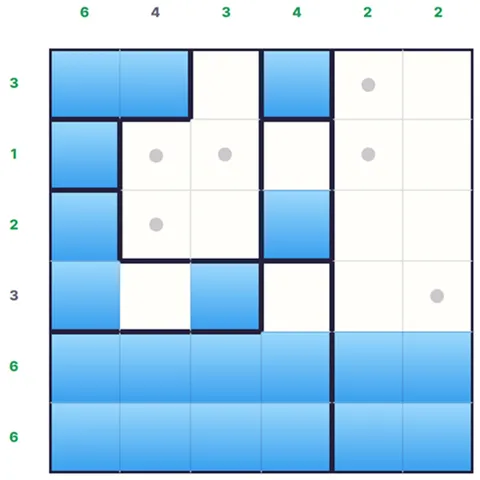







What is the Aquarium puzzle?
Aquarium is a logic puzzle popularised by Conceptis. The grid is split into connected regions called aquariums or tanks. Your job is to fill each tank with some amount of water, leaving the rest as air, so that the numbers printed beside each row and above each column are satisfied.
Each number is simply the count of water cells in that line. Like a nonogram, all the clues sit outside the grid; unlike a nonogram, the answer is shaped by the tank walls and by gravity rather than by runs of filled cells.
- The grid is divided into connected tanks (aquariums).
- Every cell is either water or air.
- A row number is how many water cells are in that row.
- A column number is how many water cells are in that column.
- A well-made puzzle has exactly one solution and needs no guessing.
The water rule: flat levels and gravity
Everything that makes Aquarium special comes from one physical idea: water finds its level. Within a single tank, water cannot float. If any cell of a tank holds water, then every cell of that same tank in the same row holds water too, and every cell of that tank below it is water as well.
Flip that around for air: if a cell is air, then every cell of the same tank above it is also air. So each tank fills from the bottom up with a flat surface, and the only question for a tank is how high its water rises.
- Within one tank, every cell in a row is all water or all air.
- Water fills a tank from the bottom upward.
- You can never have water sitting directly above air in the same tank.
- Different tanks can have completely different water levels.
- Tanks are independent — a wall stops water from spreading sideways.
How to solve an Aquarium
Start at the extremes. A row or column clue equal to the grid size means the whole line is water; a clue of zero means the whole line is air. Those certainties spread fast, because filling one cell often forces a whole tank-row or the cells below it.
Then combine the totals with the tank shapes. If a tank only touches a column near the bottom, raising its level adds water to that column in a predictable way. Counting how much water a tank must contribute to a tight row or column usually pins its level exactly.
- Mark full lines (clue equals the size) and empty lines (clue zero) first.
- When you place water, carry it sideways across the tank and downward.
- When you place air, carry it sideways across the tank and upward.
- Compare each clue with how much water the crossing tanks can supply.
- Use the unique solution: you never need to guess, only to deduce.
Aquarium vs other grid puzzles
If you enjoy nonograms, the edge clues will feel familiar, but Aquarium replaces 'runs of filled cells' with 'a flat water level inside a region.' If you enjoy region puzzles like Nurikabe or Suguru, the tank shapes will feel familiar, but here the regions behave like real containers.
That blend is what gives Aquarium its relaxed, almost meditative feel. There is no arithmetic beyond counting, the visuals are clear, and a wrong move is easy to see and undo, which makes it a friendly puzzle for newcomers and a satisfying one for experts.
Difficulty levels and why play online
Easy Aquariums use a 6x6 grid with generous clues, perfect for learning the gravity rule. Medium moves to 8x8, Hard to 10x10, and Expert to a roomy 12x12 where tanks interlock in trickier ways and the totals carry more weight.
Playing online keeps the water tidy: tap to pour, tap again to mark air, and the row and column numbers turn green as soon as they are satisfied. Your progress saves locally in your browser, and every grid is checked for a single solution, so an Aquarium always rewards careful logic.
- Easy: a 6x6 grid to learn the flat-water rule.
- Medium: an 8x8 everyday challenge.
- Hard: a 10x10 grid with interlocking tanks.
- Expert: a 12x12 grid for confident solvers.