
What is Str8ts?
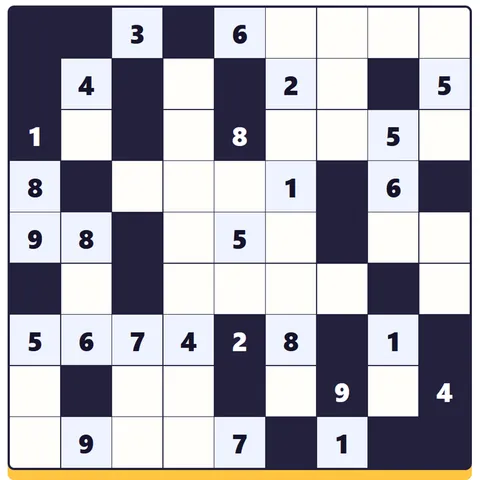
Str8ts is played on a 9x9 grid of black and white cells. You write the digits 1 to 9 into the white cells. As in Sudoku, a digit may not repeat in any row or column — and the numbers printed inside black cells count toward that no-repeat rule too.
The defining twist is the straight. Black cells break each row and column into runs of white cells called compartments. The numbers you place in a single compartment must be consecutive, like 4-5-6 or 7-8-9, although you can write them in any order. Unlike Sudoku there are no 3x3 boxes, and a row does not have to use all nine digits.
- White cells are filled with the digits 1 to 9.
- No digit repeats in a row or column (black clue numbers count).
- Each run of white cells is a straight: consecutive numbers, any order.
- Black cells are walls; a number inside one is a fixed clue.
- A well-made puzzle has exactly one solution and needs no guessing.
How the straight rule shapes the puzzle
The straight rule is what makes Str8ts feel different. Because the numbers in a compartment have to be consecutive, the value you place in one cell tightly limits its neighbours. A compartment of three cells, for example, can only be one of the windows 1-2-3, 2-3-4, all the way up to 7-8-9.
That gives you a fast way to rule out digits. If a three-cell compartment already contains a 5, the other two cells must come from {3,4,5,6,7} and together with the 5 must form a straight — so a 9 simply cannot appear there, even though nothing in the row forbids it yet.
Starting techniques
Look first at the extremes. A 1 placed in a compartment forces every other cell to be higher, because there is no 0 to sit below it; a 9 forces every other cell to be lower. Short compartments are powerful too: a two-cell compartment containing a 1 must hold a 2, and one containing a 9 must hold an 8.
Then combine straights with the row and column. The black clue numbers remove digits from their whole row and column, and a digit forced into one compartment is removed from the rest of its line. Switch on Auto notes to see the consecutive-aware candidates for every white cell at once.
- Use 1s and 9s to push a compartment up or down.
- Solve the shortest compartments first.
- Remember black clue numbers block their row and column.
- Compare the high and low ends each compartment can reach.
- Use Notes and Auto notes to track candidates as straights tighten.
Str8ts vs Sudoku
Str8ts keeps the satisfying no-repeats backbone of Sudoku but trades the 3x3 boxes for black walls and straights. The result feels familiar yet fresh: rows and columns are shorter puzzles in their own right, and the consecutive rule creates chains of logic that Sudoku never produces.
Many Sudoku fans find Str8ts a natural next step because the candidate-tracking skills carry straight over. The black clue numbers and the straight constraint simply give you extra, different ways to eliminate, which keeps even small grids interesting.
Difficulty levels and why play online
Easy Str8ts puzzles hand you more clues and shorter straights, so the deductions stay close to the surface. Medium asks for steadier candidate work, while Hard and Expert strip away clues and lean on longer compartments and the range trick.
Playing online keeps everything tidy: select a white cell, type a digit, and the board highlights its row and column while wrong entries show in red. Your progress saves locally in your browser, and every grid is checked for a single solution, so a Str8ts always rewards pure logic.
- Easy: more clues and short, friendly compartments.
- Medium: a balanced everyday straights puzzle.
- Hard: fewer clues and longer compartments.
- Expert: minimal clues that lean on the straight logic.