Star Battle rules
Star Battle is a logic puzzle on a grid split into regions. You place stars so that every row, every column and every region holds the same number of stars, and no two stars ever touch, not even at a corner. The Board menu says how many: 1, 2 or 3 stars. Every puzzle here has exactly one answer and can be solved without guessing.
You may know it as Two Not Touch, the name The New York Times uses for its two-star version. Hans Eendebak created the puzzle for the 2003 World Puzzle Championship in Arnhem.
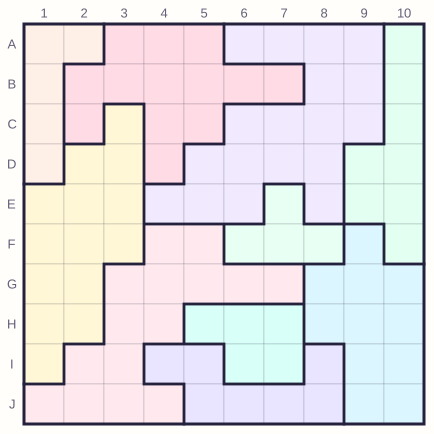
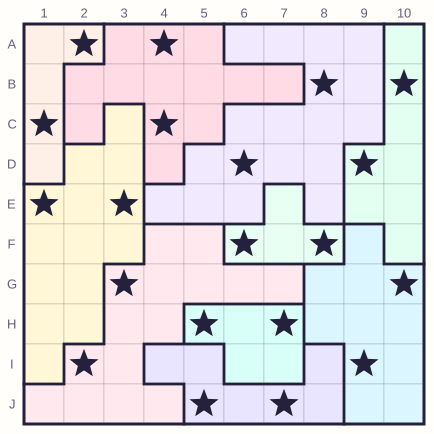
- Every row holds the chosen number of stars.
- Every column holds the same number.
- Every coloured region holds the same number.
- Stars never touch: not side by side, not above each other, not diagonally.
How to play Star Battle online
Tap or click a cell once to mark it X, which means no star can go there. Tap again for a star, and a third time to clear it. Most of the solving is marking X: a star is usually the last thing you can prove.
Hints name cells the way the board does: C4 is row C, column 4. A region takes the name of its first cell, reading from the top left, so region B2 is the one whose highest, leftmost cell is B2.
- Drag across cells to mark several X at once. On a phone, start the drag sideways, because a swipe up or down scrolls the page.
- Right-click or press and hold a cell to place a star straight away.
- Keyboard: arrow keys move, X marks, S places a star, Delete clears, H asks for a hint, P pauses, Ctrl+Z and Ctrl+Y undo and redo.
- Hint explains the next step and shows it on the board. Nothing changes until you press the button under the explanation.
- Switches under the board: broken rules marked in red (on unless you turn it off), a faint X around each star, star counts beside each row and column, and a check against the solution as you play.
What Easy, Medium, Hard and Expert mean
Levels here are about which ideas a puzzle needs, not about how many cells it has. The game solves each board with the techniques below, easiest first, and the hardest one it needed sets the level.
Easy needs only the first two techniques: looking at one row, column or region at a time. Medium adds No room and counting one or two regions. Hard adds counting three or more, or uses many of the Medium steps. Expert has at least one step that needs a short What if.
| Level | No room | Count 1–2 | Count 3+ | What if? |
|---|---|---|---|---|
| Easy | 0% | 0% | 0% | 0% |
| Medium | 65% | 65% | 0% | 0% |
| Hard | 58% | 37% | 95% | 0% |
| Expert | 58% | 45% | 58% | 100% |
Share of boards that use each technique at least once: 60 of the game's 10×10 two-star boards per level, solved by its own hint ladder.
Daily Star Battle, sharing, printing and your stats
Daily puzzle: one 10×10 two-star board a day, the same for everyone: Easy on Monday, Medium on Tuesday, Wednesday and Sunday, Hard on Thursday and Friday, Expert on Saturday. Solve it on consecutive days to build a run.
Share gives you a link to the board on screen. The link holds the board, not the answer, so it can't spoil anything. Print makes a PDF of the board and its answer, or a pack of up to 50 puzzles with answers. Sheets are black and white, with thick walls between regions, so any printer will do. Small stars above each puzzle show how many stars each row, column and region needs.
Your stats show puzzles solved, best time and average for each board and level. They stay in this browser and nobody else sees them. A puzzle solved with hints counts, but only hint-free solves can set a best time.
How to solve Star Battle: just enough room
Two things happen after every star, and they do most of the work. Its eight neighbours can't hold a star, and when a row, column or region has all its stars, the rest of it can't hold any more. The game's hints take both for granted, and the faint X switch draws the first one for you.
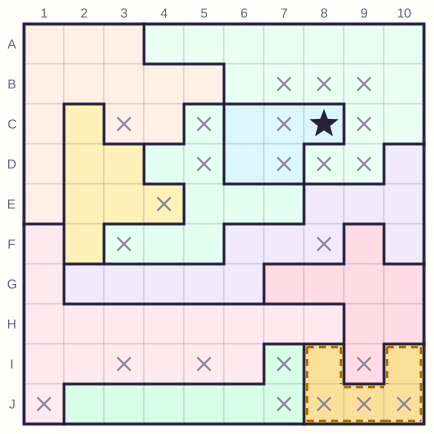
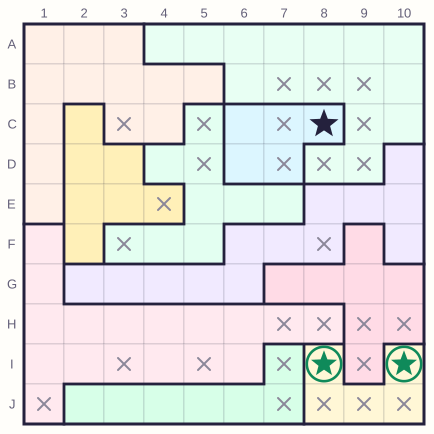
That leaves the first real technique: if a row, column or region needs as many stars as it has cells left, all those cells are stars. In the highlighted region, I9 and the whole of its part of row J are already ruled out. It still needs 2 stars and only I8 and I10 are open, so both get one.
Every way agrees: when all the options share a cell
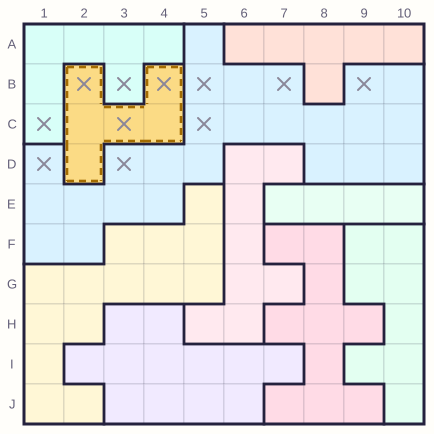
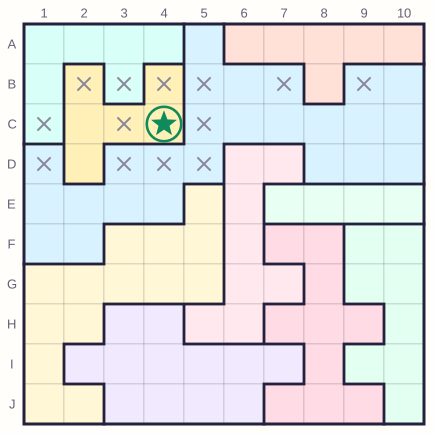
Try every way a row, column or region could still get its stars. Anything they all have in common is certain. Region B2 has three open cells, C2, C4 and D2, and needs 2 stars. C2 and D2 touch, so they can't both be stars. Whichever one is used, the other star must be C4.
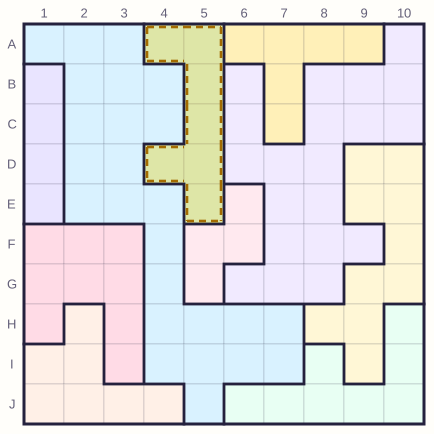
The same idea works for cells outside the region. Region A4 has 12 ways to place its 2 stars. Its bottom cells D4, D5 and E5 all touch each other, so at least one star sits on A4, A5, B5 or C5. All four of those touch B4, so B4 can't hold a star, even though it isn't in the region.
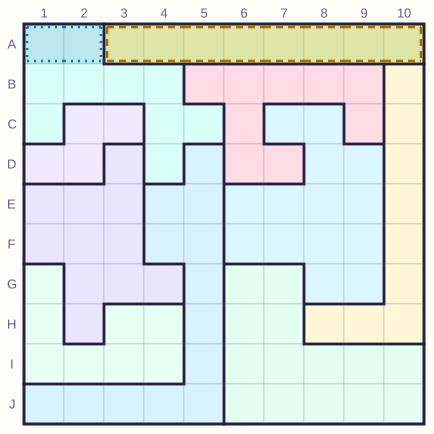
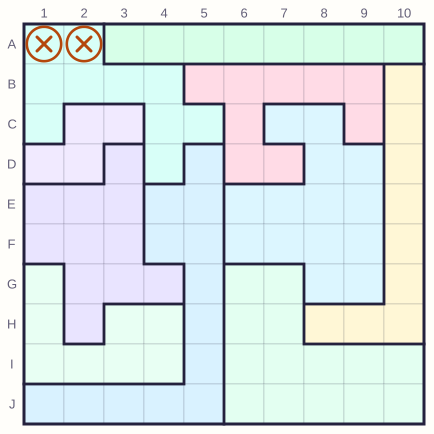
All inside is the same idea across two units. Region A3's open cells all lie in row A, and it needs 2 stars. Row A needs 2 as well, so the region supplies all of them, and the rest of row A, A1 and A2, is empty. It works in the other direction too, whenever a region or a line must supply everything the other still needs.
No room: a star that would strand a region
Now look one move ahead. Before you place a star, ask what it would take away. If some row, column or region would be left unable to get its stars, that cell is an X.
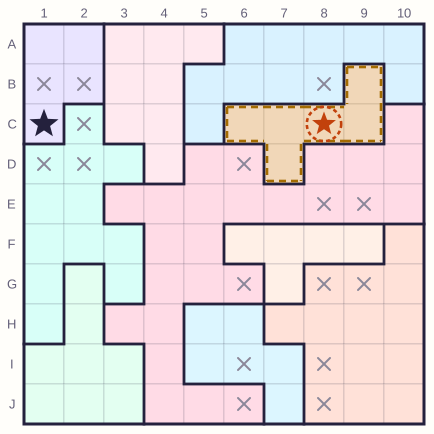
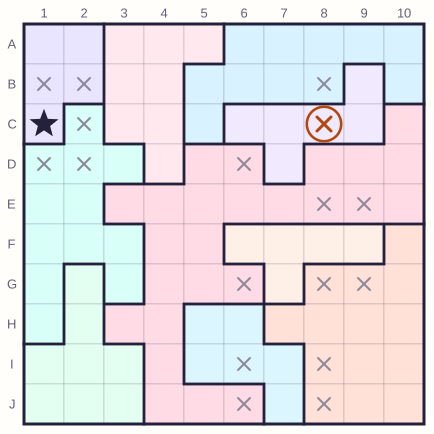
Row C already has a star on C1. A second star on C8 would finish row C, so C6, C7 and C9 would be out, and it would touch B9 and D7. Region B9 holds C8 itself but needs 2 stars, and all its other cells would now be gone. So C8 is an X.
Counting: regions that fill whole rows or columns
This is the technique that separates Star Battle from simpler puzzles, and it needs only addition. Take some regions whose open cells all lie inside the same few rows or columns. If they need exactly as many stars as those rows or columns are still missing, every remaining star in those lines belongs to those regions, and every other open cell in the lines is empty.
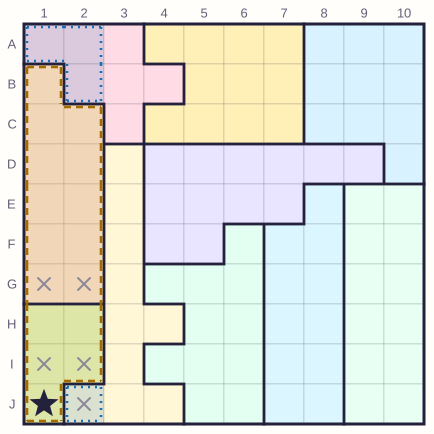
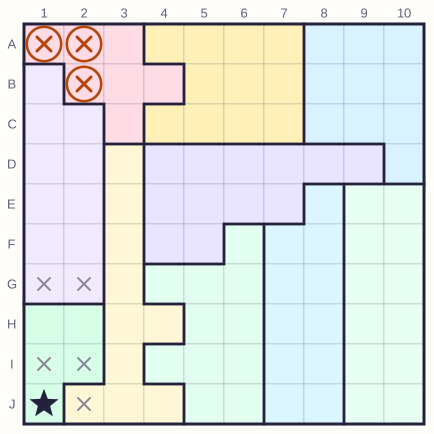
Regions B1 and H1 still need 3 stars between them: 2 for B1, and 1 for H1, which already has a star on J1. All their open cells are in columns 1 and 2. Column 1 is missing 1 star and column 2 is missing 2, so 3 again. The two regions take all of them, which rules out A1, A2 and B2.
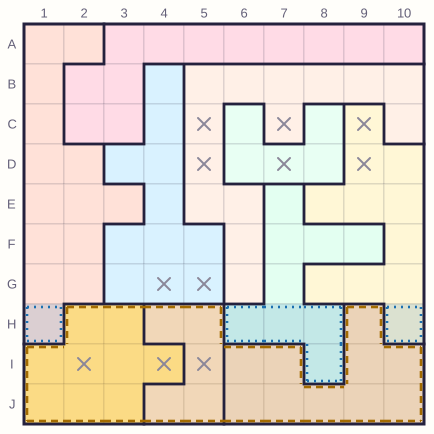
On Hard boards the same sum runs across three or more regions. Regions H2, H4 and H9 need 6 stars and fit inside rows H, I and J, which need 6. That clears H1, H6, H7, H8, H10 and I8 in one step.
To find these, start at the edges of the board and look for regions that lie across only a few lines. Add up what they need, and compare it with what those lines need.
What if? Following a chain
Expert puzzles have at least one step that no single count gives away. Pick a cell, suppose it holds a star, and follow only the steps that forces. If something breaks, the cell is an X.
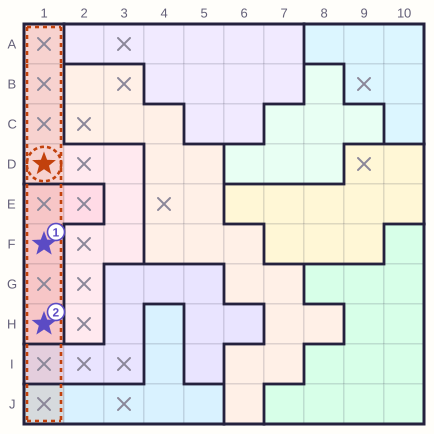
Suppose D1 held a star. That takes away C1, C2, D2, E1 and E2, and the steps above then follow by themselves: column 2 and region A1 lose more cells, and region E1 is left with only one way to place its 2 stars, on F1 and H1. Now column 1 would have three stars, D1, F1 and H1, where it can only have two. So D1 is an X.
This isn't a guess: every step in the chain is forced, and on this site the game only accepts a chain of up to 12 steps. When you try one yourself, start from a cell in a tight spot, because each supposition there forces the most. If the chain doesn't break, you've learned nothing about that cell, so undo back to where you started.
Why 9×9 and 13×13, not 8×8 and 12×12
Before any region is drawn, a board has only so many ways to fit its stars. We counted them, and two sizes that look natural turn out to be broken: 8×8 with 2 stars and 12×12 with 3 stars each have exactly 2 possible layouts.
Here's why. Stars can't touch, so any 2×2 block of cells holds at most one star. An 8×8 board splits into 16 such blocks and needs 16 stars, so every block holds exactly one, and that squeezes the whole board into two mirror-image patterns. A 12×12 board with 3 stars has 36 blocks and 36 stars, and the same thing happens. Whatever regions you draw, the answer is one of the same two, so anyone who has seen the pattern can skip the logic. That's why this game uses 9×9 and 13×13 instead.
| Board | Stars | Possible layouts | Boards ready |
|---|---|---|---|
| 6×6 | 1 | 90 | 480 |
| 8×8 | 1 | 5,242 | 680 |
| 9×9 | 2 | 664 | 1,080 |
| 10×10 | 2 | 146,510 | 960 |
| 13×13 | 3 | 42,732 | 868 |
Layouts: every way to place the stars by the row, column and no-touching rules, before regions, counted exactly. Boards: the verified boards the game deals from, across all four levels.
How the puzzles are made and checked
Each board starts from a hidden layout of stars. Regions grow around them, so that each region holds the right number of stars, and they have to stay in one piece and within sensible sizes. A one-star board has at most one single-cell region and none bigger than twice the board's width. A two-star region has at least 4 cells, a three-star region at least 6, and neither takes more than 30% of the board. Most boards made this way have more than one answer, so the game moves cells between regions until only one is left.
A board counts only when the game's own hint techniques can solve it from empty, without guessing. A solve like that is itself a proof that there's one answer, and a separate counter that searches every row layout must agree. Printed puzzles go through a third counter written separately from the game, which runs on every sheet before it's drawn.
The daily puzzle has 1,764 boards ready, one for each day to August 2031, and the first board a new visitor sees comes from a small set checked the same way.
More puzzles like Star Battle
If you like placing marks that mustn't touch, try Norinori, which fills regions with dominoes, and Tents and Trees, with its row and column counts. For pure counting along lines, Binary is a good next step, and Hashi keeps the logic but swaps stars for bridges.