



What is Sandwich Sudoku?
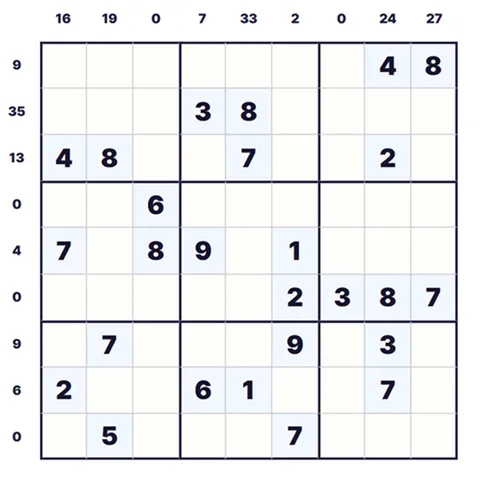
Sandwich Sudoku is a 9x9 Sudoku variant invented by puzzle setter Mark Goodliffe and popularised by The Times. The standard rules all stay: every row, column and 3x3 box must contain the digits 1 to 9 exactly once. What is new is a clue printed outside each row and column.
Each clue is the sum of the digits that sit strictly between the 1 and the 9 in that line. The 1 and the 9 act like the two slices of bread, and everything in between is the filling. The order of 1 and 9 does not matter — only the digits trapped between them count toward the clue.
- Every row, column and 3x3 box contains 1 to 9 once (normal Sudoku).
- A clue beside a row or column is the sum of the digits between its 1 and 9.
- The 1 and the 9 themselves are never counted in the sum.
- A clue can be 0 or any value from 2 to 35.
- There are no leftover givens to memorise; the clues do the work.
How to read the clues
Start at the extremes. A clue of 0 means nothing sits between the 1 and the 9, so they are neighbours in that line. A clue of 35 means the filling is 2+3+4+5+6+7+8, every middle digit, so the 1 and the 9 sit at the two far ends of the line with seven cells between them.
Near-extreme clues are almost as powerful. A clue of 34 needs six digits summing to 34, which can only be 4+5+6+7+8 plus one more from the high end, pinning the buns close to the ends. Small clues like 2, 3 and 4 force a single filling digit, so the 1 and the 9 must be exactly two cells apart.
- Clue 0: the 1 and 9 are adjacent — no gap at all.
- Clue 35: the 1 and 9 are at opposite ends of the line.
- Clues 2, 3, 4: exactly one digit between the buns (a 2, 3 or 4).
- Big clues (33, 34, 35): the buns are pushed toward the ends.
- Small clues (0–4): the buns are crammed close together.
From clue to gap: the key technique
Every clue limits how many cells can fall between the 1 and the 9, and that 'gap length' is where Sandwich Sudoku really bites. Because the filling is made of distinct digits from 2 to 8, each clue value only allows certain gap sizes. A clue of 3 can only be a single 3 (one cell), while a clue of 30 needs at least four big digits (a four- or five-cell gap).
Once you fix the gap length for a line, you know how far apart the 1 and the 9 are, which restricts where they can go. Cross that against the 3x3 box rule and the other lines, and the buns lock into place. After the 1 and 9 are settled across several lines, the puzzle often collapses into ordinary Sudoku scanning.
How to play online
Pick a difficulty and select any cell to begin. Use the number pad or your keyboard to place digits, and turn on Notes to pencil in candidates while you reason about where each 1 and 9 must live. Auto notes fills every empty cell with its current Sudoku candidates so you can focus on the sandwich logic.
The board highlights the row, column and box of the selected cell, and the clue beside the active row and column lights up so you can keep the relevant sum in view. Your progress saves locally in your browser, so you can pause a tough grid and return to the same sandwich later.
- Select a cell, then tap a number or press 1–9.
- Use Notes and Auto notes to track candidates.
- Use Hint to reveal one correct cell when stuck.
- Undo and Erase let you walk moves back safely.
- Easy keeps more givens; Expert leans almost entirely on the sandwich clues.
Difficulty levels and why play Sandwich Sudoku
Easy puzzles keep more starting digits so you can practise reading clues without much pressure. Medium is a balanced daily challenge, Hard strips away givens so the sandwich sums carry more of the solve, and Expert leans almost entirely on the borders, rewarding players who enjoy hunting for the bread.
Sandwich Sudoku is a favourite of competitive solvers because it blends light arithmetic with deep placement logic, and it has very little of the visual clutter of cage or arrow variants. Every generated grid here is checked for a single solution, so you never need to guess — only to read the sandwich correctly.
- Easy: more givens and gentle clue reading.
- Medium: a balanced everyday sandwich.
- Hard: fewer givens, more clue-driven deduction.
- Expert: the borders do nearly all the work.